







Reliable and efficient power distribution is the backbone of modern residential, commercial, and industrial operations. In urban and suburban areas, where overhead power lines may not be practical or aesthetically desirable, three-phase pad-mounted transformers provide an ideal solution. These transformers are compact, secure, and designed for ground-level installation, making them a critical component in underground distribution networks. Understanding how to deploy and manage these transformers effectively is essential for optimizing power distribution and maintaining system reliability.
This article explores the functionality, advantages, installation considerations, performance optimization techniques, and benefits of three-phase pad-mounted transformers for efficient power distribution.
Understanding Three-Phase Pad Mounted Transformers
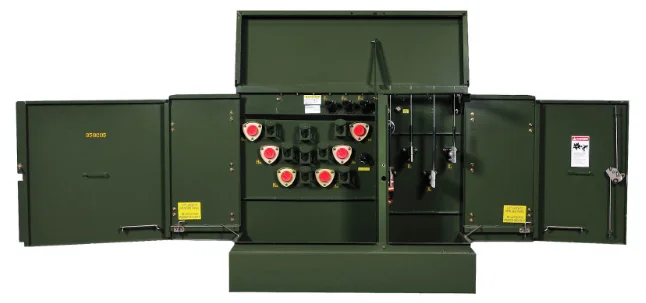
Three-phase pad-mounted transformers are specialized distribution transformers designed to convert medium voltage electricity from the distribution network to lower voltages suitable for end-users. Unlike pole-mounted transformers, pad-mounted units are installed at ground level within a lockable, weather-resistant enclosure.
Key Components
A typical three-phase pad-mounted transformer consists of the following components:
- Transformer Core and Windings: Facilitate efficient voltage conversion while minimizing energy losses.
- Pad-Mounted Enclosure: A secure, weatherproof housing that protects the transformer from environmental hazards and unauthorized access.
- High Voltage and Low Voltage Bushings: Provide safe connections to the power network and downstream circuits.
- Protective Devices: Fuses and surge arresters safeguard the transformer from overcurrent and transient voltage events.
- Grounding System: Ensures the safe dissipation of fault currents to prevent electrical hazards.
Functionality
These transformers operate using electromagnetic induction, transferring energy from high-voltage primary circuits to low-voltage secondary circuits. They are designed to handle three-phase power, ensuring balanced distribution and minimizing voltage fluctuations across connected loads. Their compact, secure design allows installation in urban environments without compromising safety or accessibility.
Advantages of Three-Phase Pad Mounted Transformers
Three-phase pad-mounted transformers offer several benefits over traditional overhead or pole-mounted distribution systems.
Safety
- Fully enclosed design reduces the risk of accidental contact with live components.
- Grounding systems provide a safe path for fault currents, protecting personnel and equipment.
Reliability
- The transformer’s enclosure protects internal components from environmental elements, dust, and vandalism.
- Designed for continuous operation under varying load conditions, ensuring consistent power supply.
Space Efficiency
- Ground-level installation eliminates the need for poles, making them ideal for urban and suburban areas with limited space.
- Compact design allows placement in residential neighborhoods, parks, and commercial complexes without obstructing aesthetics.
Energy Efficiency
- Modern transformers are engineered to minimize copper and core losses, reducing operational costs and energy wastage.
- Three-phase operation ensures balanced power distribution, preventing uneven voltage drops and equipment stress.
Flexibility in Distribution
- Suitable for underground distribution networks where overhead lines are impractical.
- Can be configured for delta or wye connections depending on network requirements.
- Supports a wide range of load types, including residential, commercial, and industrial applications.
Installation Considerations
Proper installation of three-phase pad-mounted transformers is crucial for ensuring efficiency, safety, and longevity.
Site Selection
- Choose a location with adequate ventilation to prevent overheating.
- Ensure easy access for maintenance and inspection.
- Avoid areas prone to flooding, excessive heat, or high vehicular traffic.
Foundation and Mounting
- Construct reinforced concrete pads to provide stable support for the transformer’s weight.
- Ensure proper leveling and alignment to prevent stress on bushings and connections.
Electrical Connections
- Connect high-voltage input and low-voltage output circuits according to design specifications.
- Verify phase alignment and proper grounding to maintain system stability.
- Install protective devices, including fuses, circuit breakers, and surge arresters, to safeguard the system.
Compliance with Standards
- Follow local and international electrical codes such as IEC 60076 or ANSI C57 series.
- Ensure all components are certified and rated for their specific voltage and load conditions.
Performance Optimization Techniques
To maximize the efficiency and reliability of three-phase pad-mounted transformers, several techniques can be applied.
Load Management
- Analyze and balance loads across all three phases to prevent overloading and uneven voltage drops.
- Implement load monitoring systems to track energy consumption and identify peak usage periods.
- Use predictive analysis to plan for future load increases, ensuring transformers are not overloaded.
Thermal Management
- Monitor transformer temperature to prevent overheating and insulation damage.
- Ensure adequate ventilation around the enclosure and consider oil-immersed transformers with cooling features for high-load environments.
- Periodically inspect and maintain cooling systems to sustain optimal performance.
Harmonic and Voltage Quality Management
- Deploy harmonic filters to mitigate distortion from nonlinear loads such as variable frequency drives and large electronic devices.
- Monitor voltage levels to ensure consistent output across all connected loads.
- Use protective relays and surge arresters to guard against voltage spikes and transients.
Regular Maintenance
- Conduct routine inspections for wear, corrosion, and loose connections.
- Perform thermal imaging and electrical testing to detect potential hotspots or faults.
- Schedule preventive maintenance to reduce unplanned outages and extend transformer lifespan.
Integration with Smart Grid Systems
- Equip transformers with sensors for real-time monitoring of load, temperature, and voltage.
- Connect to advanced distribution management systems (ADMS) for predictive maintenance and automated load adjustments.
- Utilize remote monitoring to identify anomalies before they escalate into system failures.
Benefits of Efficient Three-Phase Pad-Mounted Distribution
Optimizing power distribution using pad-mounted transformers provides multiple advantages for utilities and end-users:
Enhanced Operational Reliability
- Consistent voltage delivery ensures the smooth functioning of residential, commercial, and industrial loads.
- Reduced risk of outages due to improved load management and fault detection.
Energy and Cost Savings
- Minimizing losses in transformer cores and windings lowers operational energy costs.
- Preventing overloading and damage reduces maintenance and replacement expenses.
Improved Safety and Compliance
- Enclosed, grounded designs protect personnel from electrical hazards.
- Adherence to electrical standards ensures regulatory compliance and reduces liability.
Scalability and Flexibility
- Modular pad-mounted transformer designs allow network expansion without major reconfiguration.
- Capable of integrating renewable energy sources and smart grid technologies to meet modern energy demands.
Conclusion
Three-phase pad-mounted transformers are essential for efficient and reliable power distribution in modern electrical networks. Their design provides safety, flexibility, and energy efficiency, while their performance can be optimized through proper installation, load management, thermal regulation, and integration with smart grid technologies.
By leveraging modern techniques and best practices, utilities and facility managers can ensure consistent voltage delivery, minimize energy losses, reduce maintenance costs, and protect both personnel and equipment. Efficient deployment of three-phase pad-mounted transformers not only enhances operational reliability but also supports sustainable and scalable power distribution solutions for residential, commercial, and industrial applications.
Investing in these transformers and adopting a structured approach to performance optimization is a strategic step toward achieving safe, reliable, and cost-effective electrical distribution networks.