







Introduction
What are the costs when a brand-new product recall is issued just before introduction because of noisy gearboxes, or when an automated manufacturing process comes to a halt for weeks because of early fatigue failure of a critical gear used in the transmission system? Up to 30% of hardware project overruns and schedule overruns can be directly attributed to a critical failure in choosing a gear supplier, which is often overemphasized on price and delivery promise, and not on verifiable engineering and systemic ability.
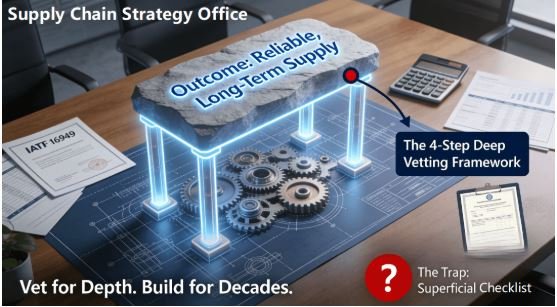
The basic issue is that there is a “superficial evaluation process.” In many cases, procurement teams treat suppliers like a list of equipment and certificates without a systematic approach to evaluate the validity of their process data, effectiveness of their quality system, supply chain stability, and ability to scale from prototype to production. This “evaluation blind spot” is a critical source of project risk. This article will present a “Four-Step Deep Vetting Framework” based on real-world projects in the industry. This article will guide you from superficial quote comparisons to a quantitative assessment of supplier process capability, preventive quality engineering, transparent project collaboration models, and a scalable supplier path. This is not a supplier evaluation process; it is a predictable investment strategy to drive supplier selection to a lower cost of ownership.
Is Your Gear Supplier Hiding Behind Certificates? How to Audit Real Process Control
A supplier’s ISO 9001 certification is a good first question to ask, but it is by no means a sufficient condition to prove a supplier’s worth. A certificate is a stamp of approval that a system is in place, but it does not prove that system is working well to deliver high-precision gear sets day in and day out. The real test is to look behind the certificate to a supplier’s real-time data-driven evidence of control over all the complex variables in gear production.

1. Demand Evidence, Not Just Assurances
Go beyond their claims and ask to see real-time Statistical Process Control (SPC) charts for critical dimensions like tooth profile error or lead deviation from their production lines. But more telling is asking for a supplier’s historical record of Process Capability (Cpk) indices for those characteristics over at least a 12-month period. If a supplier’s Cpk is consistently above 1.67, then you are seeing a supplier’s commitment to delivering high-precision gear machining, not just a stack of certificates.
2. Audit the Science, Not Just the Procedure
Precision gear manufacturing is simply materials science. The performance of a gear is fundamentally determined by the microstructure of the material, which is directly related to thermal and mechanical processing. Refer to trusted sources such as the ASM International Handbook, which provides detailed information regarding the correlation between composition and heat treatment processes and resulting gear steel mechanical properties. A competent supplier should be able to explain why they utilize a specific heat treatment procedure or finishing technique, based on this scientific approach, rather than simply stating they are following a work procedure. This is the essence of a true precision gear manufacturing company.
3. A Systematic Approach to Assessment
To execute this level of audit, it is necessary to have a systematic approach. To execute a thorough and evidence-based assessment of not only the processes but the entire manufacturing partnership, it is necessary to have a comprehensive approach. For a complete toolkit of audit checklists, templates, and case studies, you can refer to this in-depth guide on custom gear manufacturing solutions.
Beyond the Sample: How to Validate That “Prototype Performance” Will Scale to 10,000 Parts.
A perfect prototype is one thing, and production on a grand scale is another. The greatest and most expensive mistake usually occurs when one assumes that if the supplier has the capability to produce ten excellent parts, he or she will be able to produce ten thousand excellent parts. It’s the difference between the prototype and production phases, which makes many projects fail because of the element of variation.
1. The “Digital Thread” from Prototype to Production
A good supplier must be able to articulate their strategy for capturing the “success factors.” Ask the supplier how they transfer their knowledge. The precise parameters, fixturing, and inspection criteria developed during the prototype phase must be structurally documented and easily transform into the production control plan. Using a formal framework like the Production Part Approval Process (PPAP) defined in industry standards such as IATF 16949 ensures the transfer of these critical elements occurs in a controlled and predictable way, not by tribal knowledge, which forms the basis of a reliable supplier of gears.
2. Scrutinize Material and Process Consistency
Press them on their answers to these questions: How do you guarantee the material properties, such as hardness and grain structure, will be the same between the prototype batch and the production run 6 months down the road? What process control measures are in place to ensure heat treatment furnace performance will be the same with varying loads? How do they compensate for tool wear over the course of thousands of parts? The quality of their answers will tell you if they’re working with process variation or just relying on luck and inspection-based quality control.
3. The True Test: A Pilot Production Run
The best way to validate their quality processes is to request a small-scale pilot production run. Place an order with them for 50-100 parts, processed with the same settings and processes they would use for the full production run. Analyze statistically the critical performance characteristics of the parts produced in the pilot run. The variation in the results of this pilot run will be the best predictor of the quality of the parts produced for you.
Are You Defining “Quality” Correctly? From Dimensional Specs to Functional Performance.
For gears, meeting a 2D drawing is only the first step. Real quality is how it performs in use. Performance includes how it performs under load and over its life in your application. A gear may meet all specifications in a CMM test but fail in use due to subsurface stresses or metallurgical properties. Changing one’s definition of quality from “to spec” to “fit for function” is essential.
- From Geometry to Gear Performance: It is not only necessary to check basic geometry; it is essential to demand verification of functional characteristics. For example, for a transmission gear, tooth contact pattern analysis is required (noise and efficiency), surface residual stress verification is required (direct impact on life), and material cleanliness verification is required (non-metallic inclusions per ASTM/ISO).
- Require the Data, Not Just the Stamp: Don’t settle for the supplier’s “Certificate of Conformance.” Demand the full data package from the inspection process. This means asking for the raw data from the gear analyzers (profile, lead, pitch), the Material Test Report (MTR) data directly from the steel mill, and the heat treatment lot certifications. A supplier with strong confidence in their processes will be more than willing to open the books. The extent to which they collect and analyze data is a direct correlation to the quality of their high-end gear manufacturing capabilities.
- Partnering for Functional Excellence: The production of such high levels of functional quality on such a massive scale requires the expertise and knowledge of a supplier with integrated capabilities. This means finding a manufacturer that doesn’t just cut metal, but understands the intricacies of the processes involved with the interaction of metallurgy, thermodynamics, and precision mechanics. Thus, the translation of the idea of “functional quality” into tens of thousands of parts, each and every one of them of the highest quality, requires the expertise and knowledge of experienced gear machining companies.
How Do You Stress-Test a Supplier’s Supply Chain Before a Crisis Hits?
A supplier is only as strong as its weakest link. And its weakest link is often buried in its supply chain. Something like a hiccup in specialty steel supply, a hiccup in one of its sub-tier heat treaters, or even a blackout in its region can stop your production cold. Stress testing a supplier’s operational resilience is as important as testing its factory floor.
1. Map the Critical Path
First and foremost, map its supply chain for its critical path: raw materials (such as alloy steel bar stock/forging), primary processing (machining), secondary processing (heat treat/finishing), and inspection. For each of these steps in the supply chain, how do they manage it? For example: do they procure raw materials through a spot market or through long-term agreements with approved steel mills? Do they have strategic safety stock of key raw materials? And do they have audited and approved sub-contractors for key processes like carburizing?
2. Assess Redundancy and Contingency Plans
Research the level of their risk mitigation capability. For instance, do they have another gear grinder at the ready such as the CNC gear grinders? Is there a contingency plan with another company? Do they have a Business Continuity Plan (BCP) for unexpected events like utility outages or natural disasters? Once again, consider using a model such as the APICS SCOR to help you evaluate how well they’ve planned their supply chain in terms of reliability, responsiveness, and flexibility. This, in turn, is another way of gauging their level of maturity as a potential strategic gear manufacturing supplier.
3. Financial and Operational Health
Another aspect of supply chain resilience is how well the supplier is financially. Although difficult to assess, there are ways to do it. For example, are they investing in new technology? What is their turnover rate like? These would be key factors in determining supply chain stability, no matter how technologically advanced they may be.
The Partnership Litmus Test: Does Your Supplier Co-Evolve or Just Execute Orders?
The last difference between a vendor and a partner is co-evolution. A vendor takes orders. A partner provides you with ideas to help you create a better product, navigate problems, and continually develop their own skills in line with yours.
- The Design Feedback Loop: When it comes to quoting or prototyping, does a supplier produce Design for Manufacturability (DFM) input? A genuine partner will provide design feedbacka slight modification in a radius of a fillet, a tooth form that is simpler to manufacturing, a material change to a standard alternativewhich will lead to cost reduction, performance improvement, or increase of robustness without losing functionality.
- Strategic Alignment and Transparency: What do they see the future looking like? Have they drawn up a technology roadmap? What kind of technologies are they putting money into for instance, are they making prototypes with 3D printing or are the advanced coatings being brought in? Are there a couple of the company’s product directions that are in sync with things like lightweighting or even higher power density? Do they have a desire to cooperate together so that one could establish a joint performance review with common metrics like PPM defect rate or on time delivery? The level of transparency, which is this very one, is the core of a successful partnership in gear manufacturing.
- A Culture of Problem-Solving: So when, not if, a problem occurs, observe how they react. Will they get defensive like a transactional vendor? Will they work through a transparent root cause analysis with clear corrective and preventive action plans? Will they view it as a collaborative effort to solve the problem to strengthen the process? It is perhaps one of the most telling signs of a vendor who wants to work with you to build a more resilient and innovative business.
Conclusion
Choosing a precision gear supplier is no longer a simple buying decision. It’s a big decision that can even affect product reliability, business resiliency, and brand reputation. In a world where manufacturing competitiveness is increasingly a race of supply chains and innovation ecosystems, selection of a precision gear supplier is not only a decision of procurement but also a business decision with far, reaching implications in product reliability, business resiliency, and brand reputation. One method to go from a risky decision to a strong decision for a sustainable competitive advantage is using a four, step methodology that measures process evidence, systemic maturity, collaborative transparency, and evolutionary potential. It is not a decision about a supplier, but a decision about a partner in your future success.
FAQs
Q: What’s the first step if I can’t visit a potential gear supplier’s factory in person?
A: Start with a “Documentary Deep Dive.” Ask for a full, redacted Project Dossier of a previous job comparable to yours. The level of detail and honesty in this dossier can serve as a very good indication of their operational discipline and overall quality management systems.
Q: How can I verify their quality claims without relying solely on their final inspection report?
A: Make a two, level verification plan. One, for initial prototypes, require that safety, critical features be checked by a third, party lab that both sides agree on. Two, for the production phase, negotiate the right to conduct surprise audits and source inspections at their plant, along with well, defined penalties for non, compliance.
Q: What is a realistic timeline for thoroughly qualifying a new strategic gear manufacturing partner?
A: Thoroughly qualifying a new strategic gear manufacturing partner from initial RFQ with technical questionnaires, document review, potential audit, trial order production, validation will span typically 8 to 16 weeks. Such upfront investment is indispensable for strategic, high, value, or safety, critical components so as to avoid years of operational risk.
Q: Should a super low price in a quote automatically exclude a supplier? Answer:
A: No, not automatically. In fact, the usual practice would be to delve into a detailed cost analysis upon a very low quote. A very low or extremely low offer is generally a red flag, it can mean a lower grade of materials, missing required processes, or an unprofitable business model. Always seek complete visibility into the main cost components to get to the root of the price.
Q: How to handle urgent prototyping needs and still do a full partner qualification? Answer:
A: Treat the prototype urgency as a first step of the qualification. In this way, you can test the supplier’s capability live in a fairly low, risk, high, value manner, although they might be under pressure from real conditions. This can be a good way to check how well they communicate, whether they give you technical feedback (such as DFM), how close to the schedule they are, and how good is the making/packaging of the parts delivered.
Author Bio
This article reflects extensive experience in delivering projects and developing partnerships with global leaders in precision gear manufacturing and strategic supply chain management. LS Manufacturing, an ISO 9001, IATF 16949, and AS9100D certified company with full manufacturing capabilities, is not only a perfect fit in this vetting framework through its embodiment of the high standards but is also very committed to helping clients develop insightful and resilient supplier evaluation capabilities.