







The Australian legal landscape is no longer just about precedent and litigation; it is about the intersection of jurisprudence and sophisticated technology. As we move through 2026, the “New Law” era has matured, with the High Court and state jurisdictions increasingly integrating digital workflows. For recent graduates from the University of Sydney, ANU, or UNSW, a Distinction-average transcript is no longer the sole ticket to a top-tier firm. Recruiters are now hunting for “T-shaped” lawyers—professionals with deep legal expertise and broad technical fluency.
The Digital Transformation of the Australian Legal Sector (2024–2026) has seen a 40% increase in the adoption of automated discovery and AI-backed contract lifecycle management (CLM). Graduates who can bridge the gap between traditional legal theory and tech-driven efficiency are securing positions at significantly higher rates.
Navigating this transition requires more than just knowing how to use a research database. If you find yourself struggling with complex jurisdictional frameworks during your studies, seeking constitutional law assignment help can provide the foundational clarity needed to focus on these emerging technical competencies. By outsourcing the heavy lifting of case law synthesis, students can dedicate time to mastering the tools that will actually define their daily practice in 2026.
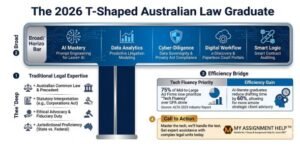
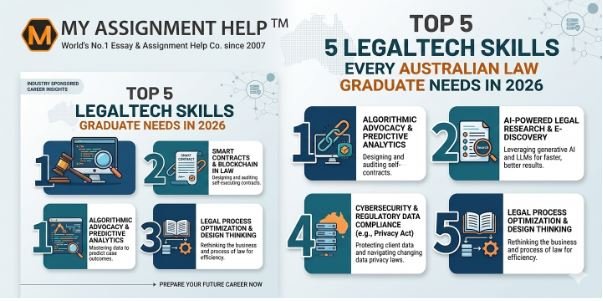
1. Generative AI Literacy and Prompt Engineering
In 2026, Large Language Models (LLMs) are no longer “new.” They are integrated into LexisNexis and Westlaw AU. However, the skill lies in Prompt Engineering—the ability to structure queries that produce accurate, hallucination-free legal drafts.
- Why it matters: According to the 2025 Australian Legal Technology Association (ALTA) Report, 75% of mid-to-large firms now use generative AI for initial draft pleadings and research summaries.
- The Skill: You must understand the “temperature” of AI outputs and how to use Retrieval-Augmented Generation (RAG) to ensure the AI only references specific Australian statutes like the Corporations Act 2001.
2. Legal Data Analytics and Quantitative Prediction
Data is the new “expert witness.” Modern Australian firms use analytics to predict judge behavior, settlement outcomes, and litigation costs.
- The Application: Graduates need to be comfortable using platforms that aggregate years of Australian court data to advise clients on the probability of success.
- The Skill: Basic data visualization and the ability to interpret “Probability of Outcome” metrics. Understanding how to read a litigation trend report is now as vital as reading a law report.
3. Cyber-Security and Client Data Sovereignty
With the 2024 reforms to the Privacy Act 1988, Australian lawyers have a non-negotiable duty to protect client data. Law graduates are often the “weakest link” in firm security.
- The Stakes: In 2026, a data breach isn’t just a technical glitch; it’s a professional conduct violation.
- The Skill: Mastery of encrypted communication, understanding blockchain-based document verification, and recognizing sophisticated phishing attempts targeting legal practitioners.
4. Smart Contract Architecture (Blockchain)
As Australia moves toward a more digital economy, “Smart Contracts” on Ethereum or Hyperledger are becoming standard in property law and supply chain disputes.
- The Shift: You don’t need to be a coder, but you must be able to “read” the logic of a self-executing contract to ensure it aligns with Australian contract law principles (Offer, Acceptance, Consideration).
- The Skill: Understanding the bridge between natural language contracts and executable code.
5. Virtual Hearing and e-Discovery Management
The “Paperless Court” is now the default. From the Federal Court to local tribunals, digital evidence management is the standard.
- The Requirement: Proficiency in e-Discovery platforms like Relativity or Nuix.
- The Skill: Managing “Cloud-to-Court” workflows—ensuring that digital evidence is admissible, correctly tagged, and securely uploaded to court portals under the Evidence Act 1995.
The Path Forward for Graduates
The transition from law school to the professional environment is notoriously steep. Many students find that the technical demands of modern practice leave little room for the rigorous writing required in their final units. Utilizing assignment help online allows graduates-to-be to maintain their academic standing while they undertake internships or certifications in the LegalTech skills mentioned above.
Balancing the “Black Letter Law” with these five pillars is the only way to remain competitive in an AI-augmented Australian market.
Key Takeaways
- AI is a Tool, Not a Replacement: Master prompt engineering to enhance your drafting speed.
- Data Informs Strategy: Use analytics to give clients evidence-based advice on litigation.
- Security is Ethics: Protecting digital files is part of your fiduciary duty.
- Adaptability: The tech used in 2026 will evolve by 2028; focus on the logic, not just the software.
Frequently Asked Questions (FAQs)
Q: Do I need to learn how to code to be a lawyer in 2026?
A: No, but you need “computational thinking.” Understanding the logic of how software processes legal data is more important than writing Python or Java.
Q: Are Australian courts actually using AI?
A: Yes. Many administrative tasks and initial evidence reviews in the Federal Court are streamlined through AI-assisted processes, though final judgments remain human-led.
Q: Will LegalTech make junior lawyers redundant?
A: It makes inefficient junior lawyers redundant. Those who use tech to do the work of three traditional clerks will be the most valuable assets in any firm.
References
- Australian Legal Technology Association (ALTA) – 2025 Annual Industry Survey.
- Law Council of Australia – Guidelines on the Ethical Use of AI in Legal Practice (Updated 2025).
- The Privacy Act 1988 (Cth) – 2024 Reform Summary.
- Oxford Handbook of Law, Regulation and Technology (2024 Edition).
About the Author
Angelika S. is a Senior Academic Consultant at MyAssignmentHelp. With over a decade of experience in Australian legal education and a keen interest in the digital transformation of the law, she helps students navigate complex jurisdictional challenges. Angelika specializes in bridging the gap between academic theory and the practical demands of the “New Law” era, ensuring students are ready for the professional workforce.