








Introduction
The gear manufacturing industry often encounters issues such as low transmission efficiency, high noise levels, and in some cases, failure to reach the precision standard, which results in waste of energy and decrease of the lifespan of the equipment. Besides, traditional manufacturing methods still pose challenges in terms of the choice of materials, the heat treatment, and optimization of the tooth profile, so that they cannot fully meet the requirements of high precision in sectors like the aerospace, medical devices and automotive components.
This piece is going to discuss five major strategies that include advanced gear cutting technology, material optimization, heat treatment processes, tooth profile modification, and stringent quality control, to assist manufacturers in making performance breakthroughs. The following parts will explain in detail the implementation of these strategies and the tangible results they have achieved.
Why Does Gear Cutting Accuracy Directly Affect Transmission Efficiency and Noise Levels?
The Mechanical Link Between Accuracy, Efficiency, and Noise
The precision of gear cutting largely depends on the vibrations produced during meshing. Flaws in tooth profiles, errors in pitch, and wrong lead are the factors that produce irregular load distribution and impact forces during the engagement of gears. Consequently, the involvement of heat and vibrations as a result of the conversion of useful rotational energy is the main reason for the reduction in transmission efficiency and the production of noise that is perceived by listening. According to the analyses concerning gear design, the tooth profile deviations in the order of a few micrometers can cause a huge increase in vibration and power losses, which is more pronounced in the high speed applications.
Consequences of Insufficient Precision
The American Society of Mechanical Engineers(ASME)indicated when precision is lacking, two major problems can occur: energy loss and vibration excitation. Inaccuracies cause non, uniform contact patterns which in turn increases the sliding friction and localized stress. This would not only lead to wastage of energy but also to a faster wear of the material. Besides, any deviation from the ideal tooth form leads to a source of excitation resulting in the generation of vibrations at the gear mesh frequency and its harmonics. This vibration is conducted through shafts and housings and is radiated as noise. It may lead to bearing failure or structural fatigue prematurely.
Modern Technologies for Micro-Level Precision
Achieving the necessary tolerances to mitigate these issues requires advanced manufacturing technologies. Modern CNC controlled gear hobbing and grinding processes have revolutionized the field.
- CNC Gear Hobbing and Shaping
These techniques provide very repeatable and precise creation of gear teeth.These techniques provide that are very repeatable and precise creation of gear teeth. By using CNC control different phases like workpiece orientation, cutting and feeding directions, production are controlled in a very consistent manner to ensure excellent pitch and profile accuracy of the resulting gears which can be utilized in many different applications even before they are hardened.
- Precision Gear Grinding
To ensure the greatest precision, grinding of the gears is a must, especially when it comes to gears that are hardened. This operation involves taking off tiny slices of material in order to fix the changes caused by the heat treatment and to get the final shape of the teeth. Modern gear cutting services use CNC gear grinders with real, time compensation that can maintain profiles to 2 microns only, which is equivalent to very high standards such as DIN Class 4 or even Class 3. To get a full picture of these methods, check out the detailed guide on gear cutting and manufacturing.
How to Select the Most Suitable Gear Material to Enhance Durability and Performance?
Choosing the best material is a vital step when gear manufacturing since it involves a trade, off between a number of mechanical properties, environmental considerations and cost. As one can imagine, the decision is very different for a high, stress Automotive Parts as against mission, critical Aerospace Components. For instance, in the case of higher, load, higher, cycle applications such as automotive transmissions and heavy machinery, alloy steels like AISI 8620 or 4140 are typically used. With an excellent balance of strength, toughness and hardenability, steel alloy through carburizing can offer surface hardness above 60 HRC while the core is still capable of withstanding shock loads.
On the contrary, in aerospace, the top priority is the strength, to, weight ratio, therefore high, grade alloys like 9310 steel or even titanium alloys are the material of choice for gears, despite the higher costs and Precision Manufacturing challenges. Stainless steel grades (e.g. 304 440C) are favored for their corrosion resistance, hence are considered suitable for medical, food processing, or marine environments. However, their wear resistance does not usually match that of hardened alloy steels.
When noise reduction, lightness and chemical resistance are the factors, one should consider engineering plastics like Polyoxymethylene or Nylon, as these materials are frequently used for consumer electronics, light, duty mechanisms, and even certain Medical Device Manufacturing parts. Getting the right material is all about aligning the hardness, tensile strength, fatigue limit, and environmental resistance of the material with the specific operational needs and life cycle of the application.
How Do Advanced Heat Treatment Processes Enhance Gear Strength and Wear Resistance?
Exact cutting produces the external shape of a gear, yet it is the heat treatment of the gear core that ultimately makes it high, performing and strong. Stages such as carburizing, induction hardening, and nitriding do not only add value as extra, degree measures but are fundamentally the main steps towards efficient, high, powered gearing capable of sustaining long, term use, most especially in custom gear cutting enterprises.
Carburizing is generally acknowledged as the primary method used for applications involving very high surface contact stresses. It consists in the diffusion of carbon into the surface layer of a low, carbon steel gear in a controlled atmosphere, and after that the piece is quenched. As a result, the surface becomes extremely hard and resistant to wear (up to 62 HRC), yet the core does not lose its ductility, ensuring that it can absorb impacts. The depth and uniformity of this hardened case are very strictly managed in order to avoid the problems of the early occurrence of pitting or even tooth breakage.
At a relatively lower temperature, nitriding introduces nitrogen into the surface layer of a part. By doing so, a very high surface hardness is achieved along with minimal distortion, making it perfect for precision, finished gears that are not allowed to be subjected to grinding after heat treatment. Besides, it significantly raises the fatigue strength and corrosion resistance of the material. Top gear manufacturing companies go to great lengths to keep furnace atmospheres, temperatures, and quenching media under very close control to drastically reduce the chances of the development of defects such as excessive distortion, soft spots, or cracking. Through this better understanding of metallurgy, a mechanically accurate piece can be made into a highly durable power transmission element which in turn, contributes directly to the prolonged service life of custom transmission gears.
How Do Tooth Profile Modification and Optimized Design Reduce Vibration and Noise?
Under load, even a perfectly shaped gear will change its form because of bending and Hertzian contact stresses. This change in shape will cause the loss of the correct conjugate action, making the gear edges come into contact first, resulting in the transmission error and the noise. Tooth profile modification is a small intentional departure from the perfect theoretical involute or cycloidal form that serves as a compensation for this kind of deformation. One of the common methods is tip and root relief by removing a small amount of material from the very tip and root of the tooth. This way, it’s avoided that the edges making the first contact are very harsh and thus load transmission between mating teeth is smoother. In the same vein, lead crowning adjusts the tooth face width, giving the tooth a slight barrel shape. This will make sure that under the normal load the contact point is at the center of the tooth face, and that small misalignments in the gearbox assembly are taken care of. Alternatively, these are the types of things that in certain cases of extremely quiet operation such as Medical Device Manufacturing or luxury automotive drivetrains are considered critical. Using advanced design software you can simulate loaded tooth contact which is a feature that helps you to come up with micro, geometries practically optimized and customized. This approach to design that is undertaken in advance and is based on the guidelines provided by the American Gear Manufacturers Association (AGMA) which links precision grades to noise levels introduces the highest employees and efficiency levels in custom transmission gears.
How Do International Certifications (e.g., ISO, AS9100D) Ensure Consistency in Gear Manufacturing Quality?
The Framework of Quality Assurance
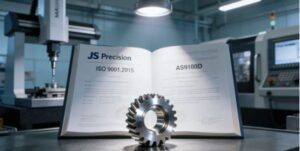
Consistency remains as essential as capability in precision gear manufacturing. Structured framework to guarantee this is through the international quality management system (QMS) certifications. ISO 9001 standards, for example, not only set the minimum requirements for a process, oriented QMS but also focus on continuous improvement, customer satisfaction, and data, driven decision, making. Any recognized custom gear manufacturer should have such a systemic approach as their foundation.
Industry-Specific Rigor
For manufacturers serving sectors with zero-tolerance for failure, more stringent certifications are mandatory.
- IATF 16949 for Automotive
This standard incorporates the main points of ISO 9001 but adds special requirements for the automotive supply chain. It requires strict control of processes, APQP and PPAP procedures that guarantee that each batch of Automotive Parts is produced in line with the specifications.
- AS9100D for Aerospace
The aerospace standard includes all the requirements of ISO 9001 and also covers aspects such as risk management, configuration control, and traceability in a very detailed manner. This essentially means that in the production of Aerospace Components, each and every raw material, process parameters, and inspection results of a gear are documented and tracked throughout its lifecycle.
The Certified Manufacturer Advantage
A manufacturer who is certified to these standards, for instance, JS Precision which holds the certifications for ISO 9001:2015, IATF 16949:2016, and AS9100D, will be able to show several benefits. The gear manufacturing methods of such a manufacturer are not left to chance but are fixed, checked, and regularly audited. As a result, there is a steady quality, a lower chance of non, compliance, and dependable delivery on time. It evidently communicates to the clients that their demands for gear machining will be fulfilled on a regular basis, from the first prototype to the final production. Check out what a certified partner can do by visiting their main services page:gear machining.
Conclusion
Producing efficient, quiet, and dependable precision gear manufacturing with minimal deviations is a challenge that can be addressed through a systems engineering approach. … Implementing the strategies discussed above minimizing advanced gear cutting and manufacturing, intelligent material selection, controlled heat treatment, proactive tooth profile modification.
Author Biography
This article was produced by a technical specialist who has worked in the precision manufacturing sector for more than 15 years and is highly knowledgeable about gear drive solutions. The author drew a wealth of knowledge on the subject from their long career and various extensive investigations of top, notch manufacturing technologies.
FAQ
Q: What are the common accuracy grades in gear manufacturing?
A: The most popular accuracy systems are ISO, AGMA, and DIN. For example, the AGMA quality levels of 12, 13 or the DIN classes 5, 7 may be considered standard for the production of high, precision gear drives. The particular grade must be determined after assessing the application load, speed, and noise requirements.
Q: What is the typical lead time for custom gears?
A: Lead time is usually determined by the complexity of the gears, the quantity, as well as other required processes. Simple gear models for rapid prototyping could be ready within 3, 5 days, whereas bigger production runs of highly precise gears may take 2, 4 weeks.
Q: How do I select a gear material for my application?
A:It is essential to consider load speed operating environment (temperature, corrosion), and cost. Alloy steel can endure heavy loads, stainless steel acts against corrosion, and engineering plastics are ideal for the situations of light, load and low, noise.
Q: Is heat treatment necessary for all gears?
A: Not necessarily. Heat treatment, such as carburizing and quenching, is a must for metal gears that will experience high contact stress and wear. This process will help increase surface hardness and fatigue strength, which should lead to longer service life.
Q: How is gear manufacturing quality verified?
A: There are various ways of verifying quality. Gear manufacturers can use coordinate measuring machines (CMM) to check the dimensions of the gears, conduct gear tooth profile and lead testing, hardness testing, and noise/vibration testing. It is crucial to pick a manufacturer that has a thorough inspection procedure and the required industry certifications.